Structural Behavior of the Space Shuttle SRM |
|
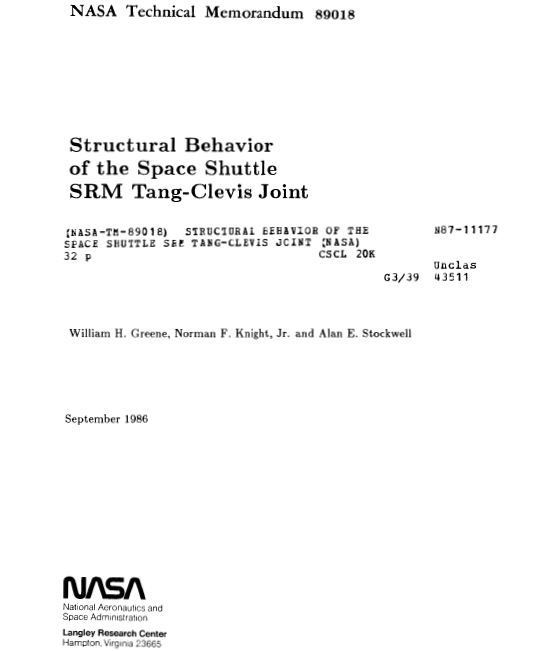
NASA Technical Memorandum 89018 by Greene, Knight and Stockwell is the result of an in-depth and complex study of the SRM tang-clevis joint. It is interesting the study focuses on the primary reason for the Challenger explosion -- "the behavior of the joint under internal pressure load". Following are three salient paragraphs lifted directly from the document and the cover page along with the first page of the report itself. Notice that the capture feature is first named as a fix for the problem which was inherent in the flawed SRM joint design. The reader is encouraged to download the entire document INTRODUCTION "The accident which destroyed the space shuttle Challenger is believed to have been caused by the failure of a case joint in the right solid rocket motor (SRM).1" "Several characteristics of the original SRM joint design have been identified as potential contributors to the failure. One characteristic is the behavior of the joint under internal pressure load. The motor case expands radially outward due to the pressure. Because the joint has a higher hoop stiffness than the case wall on either side of the joint, its radial expansion is less than that of the case wall. This nonuniform radial expansion is the primary cause of relative motion between the inner clevis arm and the sealing surface on the tang. This motion can cause the O-rings to become unseated and therefore lose their sealing capability." MODIFIED JOINT WITH CAPTURE FEATURE "The primary structural modification to improve the original tang-clevis joint adds a “capture feature” to the tang portion of the original joint as shown in figure 9."
|


Home | About Us
| © Copyright 2010 - 2026 | |
| Visitors: 154,091 | |